GLP2
T-GLP2 30mg Original price was: $160.00.Current price is: $120.00.
Back to products
Buy retatrutide
Retatrutide 10mg & 20mg Price range: $195.99 through $285.99

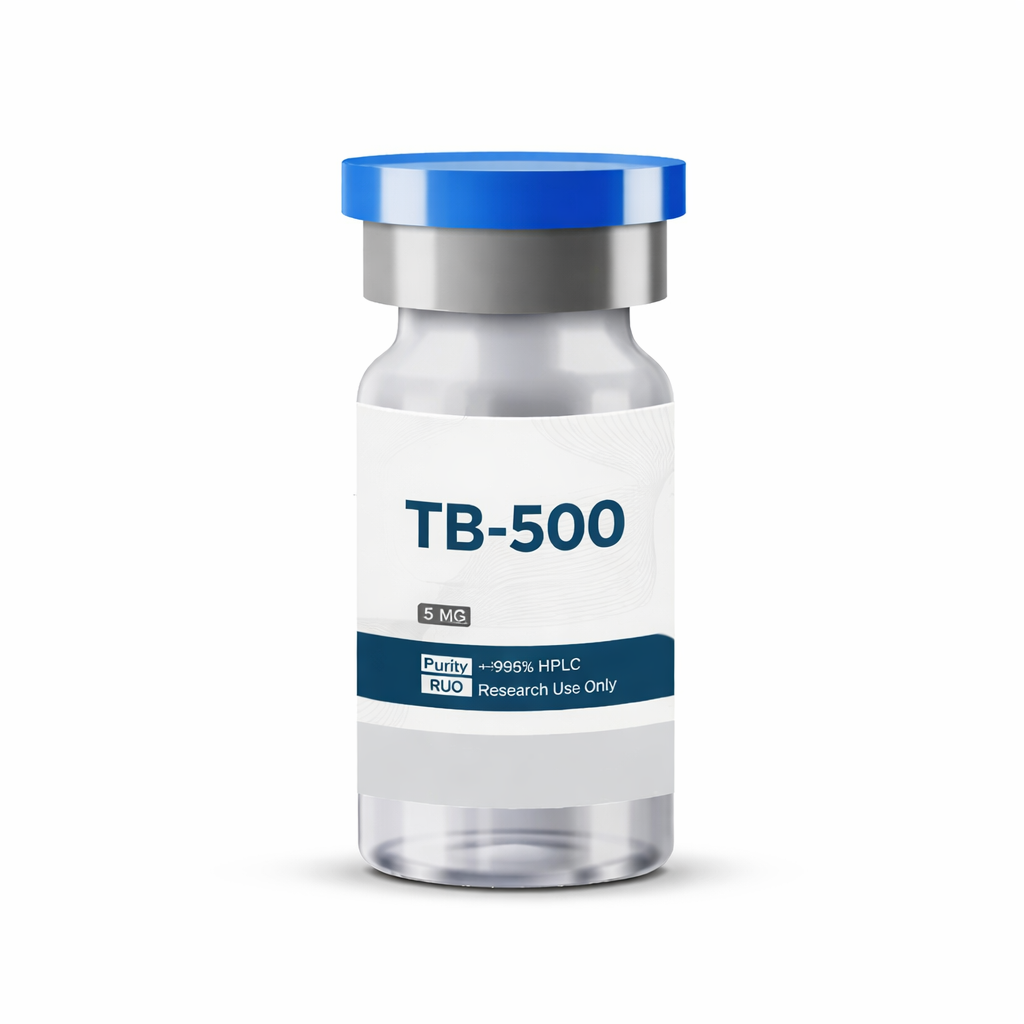
TB-500

10 mg of reagent-grade TB-500.

TB-500 is a research peptide and a synthetic N-terminated acetylated 17-23 fragment of human thymosin beta-4 (Tβ4) protein. Tb-500 has the modularity properties of Tβ4, modulating the actin nucleotide exchange and polymerisation dynamics. It promotes the lamellipodial extension and all motility in epithelial cells, endothelial cells, keratinocytes, and fibroblasts, helping in wound healing, tissue regeneration, and angiogenesis.

Original price was: $62.00.Current price is: $60.00.

Guaranteed Safe Checkout

Features & Compatibility

Product Summary – Bpc 157 tb 500 – Fragment of Tβ4 Protein

Field Details
Product Name TB-500 (Ac-LKKTETQ) – a synthetic peptide corresponding to the active actin-binding region of Thymosin β4.
Category Synthetic peptide fragment of thymosin β4; promotes cell migration, angiogenesis, and tissue remodelling.
Length 7 amino acids (heptapeptide).
Amino Acid Sequence Ac-Leu-Lys-Lys-Thr-Glu-Thr-Gln (Ac-LKKTETQ).
Molecular Formula C₃₈H₆₈N₁₀O₁₄
Molecular Weight ≈ 889.02 Da
Form & Purity Lyophilized powder for research use; purity typically ≥95% (HPLC)
Storage Store dry at ≤ –20 °C for long-term; reconstituted solutions stable at ~4 °C for roughly 10–14 days; avoid repeated freeze–thaw
Key Mechanisms of Action – Binds G-actin, modulating actin polymerisation and promoting cell migration and tissue remodelling.

– Enhances angiogenesis, endothelial differentiation, collagen deposition, and keratinocyte migration.

Research / Clinical Use Cases Investigated in preclinical models for accelerated wound healing, improved angiogenesis, tissue repair (skin, muscle), neurorepair (spinal injury), and hair growth. Human clinical data remains extremely limited.
Common AEs / Safety Signals – Reported to be well tolerated in animal and anecdotal human usage.

– minor injection site irritation

– mild systemic symptoms possible

– No formal clinical safety trials to date.

Contraindications / Warnings Not FDA-approved. Absence of human clinical validation.  Use only in research settings with proper ethical oversight. Theoretical risk: pro-angiogenic activity could pose concerns in cancer or proliferative disease. 
Regulatory / Compliance Available only as a research-use peptide; not approved for human therapeutic use. Banned by WADA (anti-doping) due to potential performance-enhancing effects.

Mechanism of Action of Bpc 157 tb 500

Pro-Angiogenic & Matrix Remodelling Signals

Preclinical data show that Bpc 157 tb 500 activates many downstream signal pathways, including angiogenesis and matrix remodelling. TB-500 activates integrin-linked kinase, which in turn stimulates the Akt pathway, leading to endothelial differentiation, capillary formation, and tissue granulation through VEGF and matrix metalloproteinases (MMPs), along with the upregulation of laminin, particularly laminin-332 synthesis. [1]

Recent research studies indicate that  Bpc 157 tb 500 plays a significant role in activating key cellular signalling pathways, particularly the PI3K-Akt-mTOR and HIF-alpha1–associated programmes, within experimental models of impaired healing. In controlled laboratory environments, these signalling cascades are closely linked to cell survival, migration, and metabolic regulation, all of which are essential processes during tissue repair and regeneration. By stimulating these pathways, Bpc 157 tb 500 is observed to enhance vascular proliferation, supporting improved nutrient delivery and oxygen availability at the cellular level.

Additionally, research highlights that TB-500 contributes to increased metabolic support for regenerating tissue, helping cells adapt to stress conditions often present in damaged environments. These molecular responses help explain the pro-migratory behaviour of cells and the pro-angiogenic effects associated with TB-500 in non-clinical research settings. Overall, TB-500 continues to attract scientific interest for its role in cellular signalling, angiogenesis-related mechanisms, and tissue regeneration pathways, strictly within experimental and research-based frameworks.

Anti-Inflammatory & Cell Survival Effects

TB-500 also has anti-inflammatory and anti-apoptotic effects in the injured tissues by modulating the inflammatory cytokines and discouraging the neutrophil adhesion. These properties of TB-500 enhance the cell survival signalling by decreasing the tissue necrosis and supporting regenerative remodelling. In multiple modules, these effects have proven to decrease the lesion size and improve the functional recovery and control of the tissues. [3]

Preclinical and Evidence-Based

  • Multiple rodent studies have shown that topical or systemic Bpc 157 tb 500 resulted in enhanced reepithelisation and angiogenesis with improved tensile strength.
  • In a human RCT of ophthalmology with full-length Tβ4, it was found to improve corneal healing and ocular comfort with safety in neurotrophic keratopathy and dry eye populations.
  • Preclinical models also explained the benefits of TB-500 in myocardial infarction, spinal cord or brain injury, and hair growth. [6]

Human systemic data is still extremely limited.

Tolerability and Safety Considerations of Bpc 157 tb 500

  • Evidence is mostly from animal studies or ophthalmic trials with full-length thymosin β4. No robust RCTs for systemic Bpc 157 tb 500 in humans.
  • Stimulates angiogenesis and migration; potential risk of tumour growth or metastasis in patients with active malignancy.
  • Online Bpc 157 tb 500 is often misbranded/adulterated, with variable peptide content, impurities, and sterility risks. COA and GMP verification are essential for research.
  • Not an approved therapeutic; prohibited in competitive sports under anti-doping regulations.

Additional information

Customer Reviews

Reviews

There are no reviews yet.

Be the first to review “TB-500”

Your email address will not be published. Required fields are marked *